
Newlywed Finances: 5 Money Talks to Have and 3 Ways to Split Bills
Updated
Many newlyweds find money hard to bring up. But if you skip the conversation, small frustrations quietly pile up. Here is the order to work through your finances as a couple, plus a few habits that keep money talks calm.
There is no single right way to handle newlywed finances. What works depends on whether you both work, whether one of you earns most of the income, and what plans you have for the next few years.
That is why the order matters: first get on the same page about where you both stand today, then choose a system that fits. This guide follows that order.
Newlywed finances: 5 things to talk about first
Before you pick a system, get a clear picture of each other's situation. Once you know these five things, most other decisions become easier.
- 1Monthly take-home pay (what actually lands in your account, not your salary on paper)
- 2Current savings
- 3Debts and payment plans (student loans, car loans, credit card balances)
- 4Fixed monthly costs (rent, insurance, phone plans, subscriptions)
- 5Big upcoming costs (a wedding, a move, a car, kids)
If sharing everything at once feels like too much, start with just two: take-home pay and fixed monthly costs. Those two are what you need most to choose how to split your money.
Do not let this turn into a review of past spending or old debt. The point of the conversation is not to judge the past. It is to decide what you will do from here.
3 ways to split household money
Once you both know the numbers, decide how to organize your money. Most couples use one of these three setups.
| Setup | How it works | Good fit for | Watch out for |
|---|---|---|---|
| Fully combined | Both paychecks go into one account and everything is paid from there | Couples who want to see the whole picture together, or expect one income to change | Feels tight unless each person has some free spending money |
| Shared bills only | Each person puts an agreed amount into a joint account and keeps the rest | Two-income couples who want some independence | Saving can become "I thought you were doing that" |
| Split by category | One person covers rent, the other covers groceries and household items | Couples who want the simplest possible start | Gets unfair when incomes or prices change, and the full picture is hard to see |
None of these is the correct one. If you are unsure, start with shared bills only and review it after about six months. Moving to a fully combined setup later, or the other way around, is not hard.
How to divide shared bills fairly
If you share household costs, decide how much each person contributes. There are two common approaches.
Split it evenly
Simple and easy to agree on. It works well when your incomes are close. When there is a big income gap, the person who earns less can run out of free spending money much sooner.
Split it by income
Say one of you takes home $4,500 a month and the other takes home $3,000, and shared costs are $3,000 a month. Split by income, that is $1,800 and $1,200. Both of you pay 40% of your take-home pay, so the burden feels more even.
Count more than money
Reduced hours, housework, and childcare can put more weight on one person in ways that do not show up in dollars. Instead of judging fairness by amounts alone, aim for a split you both genuinely agree with. That is what lasts.
Set up a joint account and one shared card
If you share costs, one joint account for household spending makes life much easier.
- Paid from the joint account: rent, utilities, groceries, household items, shared phone or internet bills
- When to fund it: right after both of you get paid
- How much to put in: start with your average shared spending over the past three months, plus a small buffer
- Choose one card for shared purchases so all household spending ends up in one place
Account ownership, joint accounts, and authorized users work differently at each bank and card issuer. Check the details with your own bank when you set things up.
Shared savings goals: "for what" and "by when"
If you start with "how much should we save each month," the purpose tends to get fuzzy. Decide what the money is for and when you need it first.
- Moving costs within the next year
- A wedding or trip in two years
- A car or saving for kids in a few years
- An emergency fund (a few months of living expenses is a common guideline)
Once the goal is clear, the monthly amount is simple math. Moving money into a shared savings account on payday, before you spend, works much better than saving whatever is left at the end of the month.
What to update after you get married
Marriage is a good moment to review your accounts and policies so nothing catches you off guard later.
- Insurance (beneficiaries, and whether your coverage overlaps)
- Phone plans (whether a family plan saves money)
- Names and addresses on bank accounts, cards, and other services
- Updates at work, such as your address or family details for benefits
Your tax filing status and eligibility for workplace benefits can change after marriage, and the rules depend on your situation. For individual decisions, check with your employer, a tax professional, or the official tax authority.
3 habits that prevent money fights
Most money arguments are not really about the amount. They come from feeling left out, as in "I didn't know" or "you decided without me."
- 1Give each person some free spending money. An amount neither of you has to report on removes a lot of small arguments.
- 2Do a 10-minute check-in once a month. Talking about money every day is tiring. Pick a day and keep it short.
- 3Look at the numbers to plan the next month, not to blame. Even after an expensive month, ending with "so what do we do next month?" is enough.
Use one budget you can both see
When only one person tracks the household budget, it easily becomes "the budget only one of us understands." If you can both see the same budget, your monthly check-in gets much easier.
In Moneypet, you can create a family group with an invite code and see each other's entries and reports. You can check a combined report for the whole household and share your budget with your partner. For entries you would rather keep private, turn on "Hide from family" when you log them, so your free spending money stays your own.
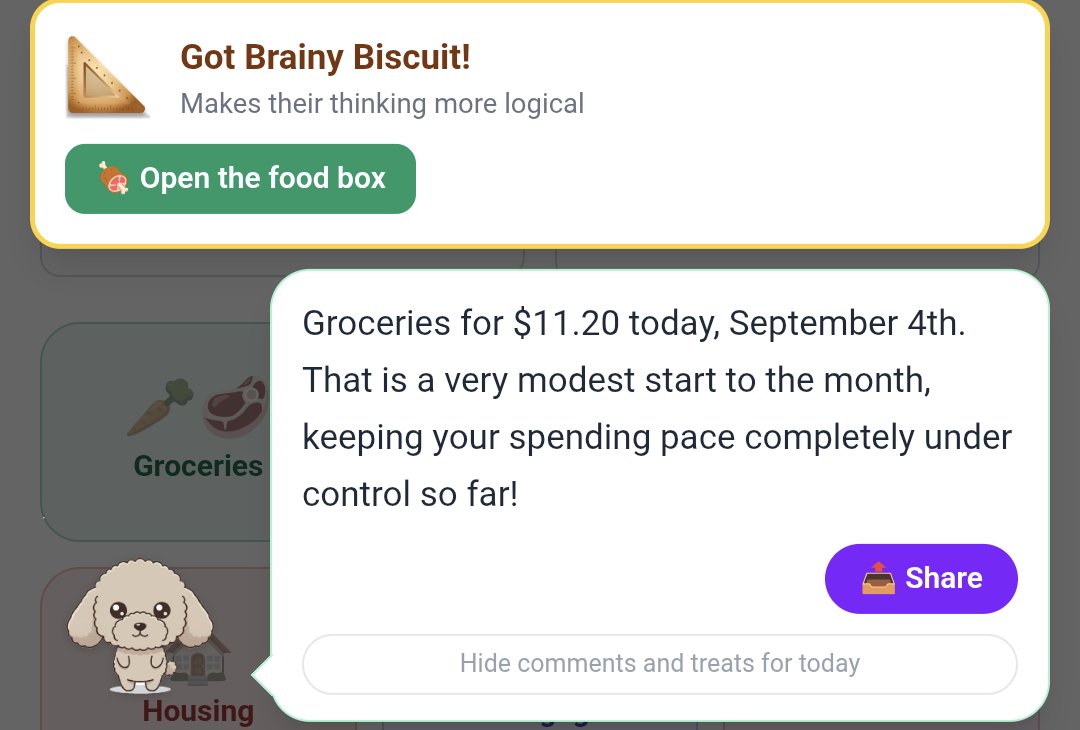
Each time you log something, your pet reacts with a short comment, which can be a fun thing to talk about together.
Start a budget for two with a pet. It is free to get started.
FAQ
Should savings from before marriage become joint money?
There is no rule. Many couples keep what they saved before marriage as their own and treat what they save after marriage as shared. Even if you keep it separate, telling each other the amount makes planning much easier.
I earn less and feel awkward about money. What can we do?
One option is to split shared costs by income but give each person the same amount of free spending money. Look at work schedules and housework too, and find a setup you both feel good about.
Who should manage the money?
Whoever enjoys it more can take the lead. But make sure the other person can see everything at any time. If only one of you knows how the money works, it becomes a problem the moment something unexpected happens.
Summary
- First, share take-home pay, savings, debts, fixed costs, and upcoming plans
- There are 3 ways to split money. If unsure, start with shared bills only and review in six months
- Split shared costs evenly or by income, and count non-money contributions too
- Set savings goals by purpose and deadline, and move money on payday
- Give each person free spending money and keep a short monthly check-in
Moneypet is a budgeting app where logging your spending earns food for your pet. Send your pet traveling and hatch insects from eggs, so you actually want to open it every day. Free to start.